When electrical contractors and EPC project managers cost up a large earthing installation, the conductor itself is typically the most visible line item. The copper earth strip specification goes on the bill of materials, three quotes come in, and procurement decides based largely on price per kilogram.
What rarely appears on the materials bill is the cost of handling that conductor on site.
On a utility-scale solar farm, a wind farm, or a major substation project, the way copper earthing conductor is packaged and delivered has a direct and measurable impact on installation labour hours, programme risk, site safety incident rates, and the long-term reliability of the earthing system itself. These are real costs. They just tend not to show up until the project is already underway.
This article looks at where those costs come from, and how specifying custom-length copper drums from the outset can eliminate most of them.
The Real Cost of Short Coils on Large Earthing Projects
Standard imported copper earth strip is typically supplied in coils of 25 to 100 metres. For a residential earthing job or a small commercial installation, this is perfectly adequate. For a utility-scale solar farm covering 150 hectares, it creates a cascade of problems that compound across the entire installation programme.
Consider a 150 MW solar farm with 600-metre row lengths
If the earthing specification calls for 40 x 3 mm copper earth strip and the contractor is working with 50-metre coils, each row of the array field requires twelve coils and eleven joins. Across 200 rows, that is 2,200 joins to be made, tested, and documented in the field. Each join requires a compression or exothermic connector, a crimping tool, skilled labour to execute it correctly, and an inspection record.
The joins themselves are not free. But the bigger cost is the labour surrounding them: the time spent unrolling and positioning each coil, managing the tangle risk as the coil unwinds across rough construction terrain, and the pace at which a crew can realistically move when they are handling multiple short coils per row rather than deploying a single continuous conductor from a drum on a cable trailer.
On large projects, the difference in installation pace between short coil supply and custom drum supply can represent days of programme time across the earthing installation sequence.
The Manual Handling Problem Nobody Budgets For
A 50-metre coil of 40 x 3 mm copper earth strip weighs approximately 36 kilograms. That is a heavy lift by any workplace health and safety standard, and it needs to be moved repeatedly: unloaded from the delivery vehicle, transported to the work area, positioned at each installation point, and often carried by hand across ground that is far from flat.
On a large solar or wind farm site, the earthing installation crew may handle hundreds of these coils over the course of the earthing programme. The cumulative manual handling exposure is significant.
The consequences are not abstract. Manual handling injuries including strains, sprains, and musculoskeletal damage are among the most common lost-time injuries on construction sites in Australia. Each incident carries direct costs including workers compensation, replacement labour, and project delay, as well as indirect costs including investigation time, documentation, and the broader impact on crew morale and programme confidence.
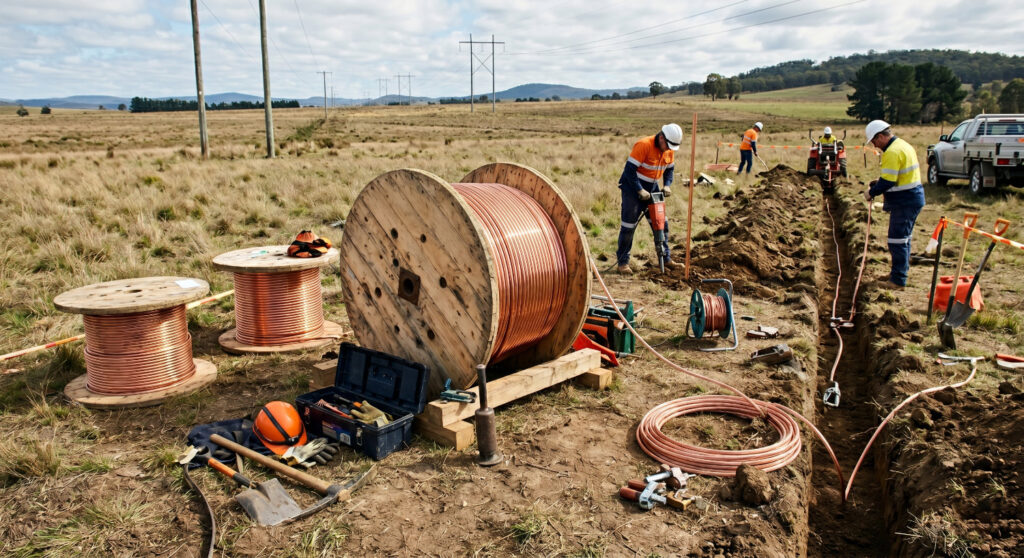
Custom drums loaded onto a cable trailer or drum stand for deployment along the earthing trench eliminate the repeated heavy lifting entirely. The conductor pays out from the drum as the trench progresses, with the crew guiding the conductor into position rather than manually carrying and positioning coil after coil. This is a fundamentally safer way to install long runs of copper earth strip, and it is faster.
How Custom-Length Drums Address These Problems Directly
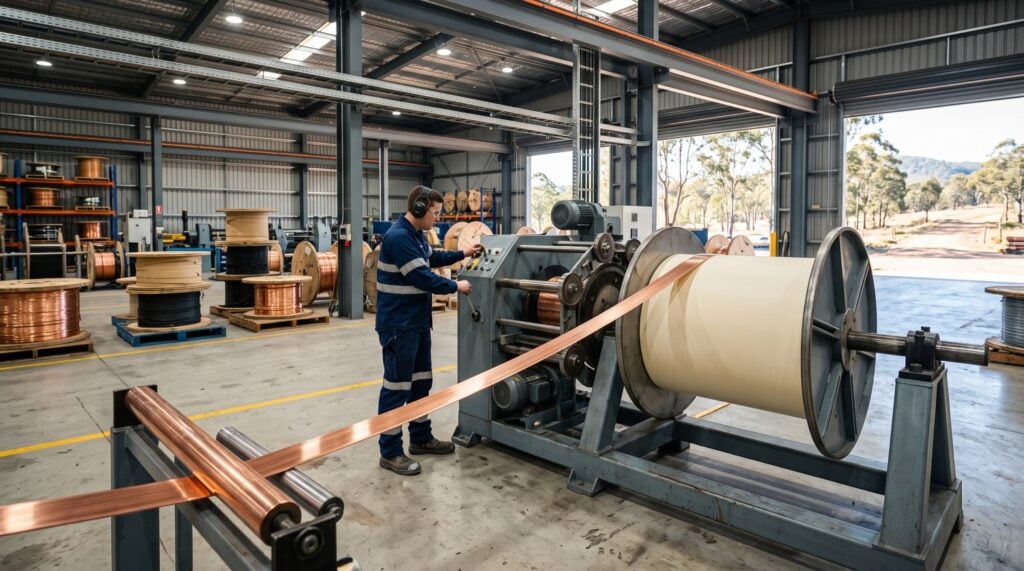
A custom drum is not simply a large coil. It is conductor supplied in a specific length, on a purpose-engineered drum, matched to the geometry of your project.
For a solar farm project, that means drums specified to match the exact row length of the array fields. For a substation project, it means drum lengths matched to the perimeter conductor runs and main grid segments. For a wind farm, it means lengths matched to the inter-turbine spacing along the collector cable trenches.
The project benefits are specific and measurable
- Joints are eliminated where it matters most. Every joint in an earthing grid is a potential failure point. It is also a potential point of increased resistance in the fault current path. By matching drum lengths to the run lengths on your project, mid-run joints in the main earthing conductors are eliminated entirely. The result is a more reliable, lower-impedance earthing system with fewer points requiring inspection and ongoing maintenance over the life of the asset.
- Installation labour is reduced. Deploying conductor from a drum on a cable trailer is significantly faster than managing multiple short coils. On large projects, the labour saving across the full earthing installation programme can be substantial enough to affect the overall project cost and programme duration.
- Manual handling exposure is dramatically reduced. Removing the repeated heavy lifting of individual coils from the installation process directly reduces the probability of manual handling injuries on site. This is not a marginal improvement. On a 200-turbine wind farm or a 300-hectare solar installation, the volume of coil handling that is eliminated by switching to drum supply is significant.
- Documentation is simplified. A single drum with a clearly labelled material test certificate covering the full drum length is far easier to manage for quality records and network owner approval than a matching set of certificates across dozens of individual coils.
- Delivery can be staged to the programme. Custom drums are manufactured to order, which means they can be scheduled for delivery to match your earthing installation sequence rather than arriving all at once and requiring on-site storage, handling, and security management.
Why This Matters Particularly on Australian Renewable Energy Projects
Australia’s utility-scale solar and wind construction programme is operating at pace. Projects are large, sites are remote, construction programmes are tight, and grid connection milestone dates carry real financial consequences if they are missed.
In this environment, the choice of copper earthing conductor supply model is a genuine project risk management decision, not just a procurement one.
Contractors who have moved to custom drum supply on large earthing projects consistently report faster installation rates, fewer site incidents related to conductor handling, and cleaner quality documentation at practical completion. These are outcomes that matter to project managers, site safety officers, and the network owners who ultimately approve the earthing system.
Global Copper Conductors: Australia’s Only Manufacturer of Copper Pancake Coils and Custom Drum Supply
Global Copper Conductors is one of Australia’s only manufacturers of copper earth strip and the only manufacturer of copper pancake coils. We supply custom drum lengths matched to project specifications for solar farm, wind farm, and substation earthing projects across Australia.
Our overnight die manufacturing capability means we can produce conductor to your exact cross-section specification and have it on custom drums ready for delivery within days of order confirmation. We work directly with project engineers, procurement teams, and EPC contractors to specify the right drum configuration for each project, and we stage deliveries to match your construction programme.
If your next large earthing project is in planning or procurement, contact our team early. The conversation about drum length and delivery staging is much more valuable before the earthing installation starts than after.
Talk to our team about custom drum supply for your next project.